Ainsworth Theory of Attachment and the Strange Situation
The Ainsworth theory of attachment is best understood as Mary Ainsworth's evidence-based expansion of John Bowlby's original attachment theory. Bowlby described why children seek closeness to caregivers when they feel threatened. Ainsworth showed how those bonds could be observed, compared, and understood through real behavior. Her Strange Situation work made attachment patterns visible: safety-based, avoidant, and resistant or ambivalent, with disorganized attachment added later by Mary Main and Judith Solomon. If you are exploring your own relationship patterns, a private attachment style self-exploration tool can be a gentle starting point, as long as you treat the result as reflection rather than a clinical label.
What Was Ainsworth's Theory of Attachment?
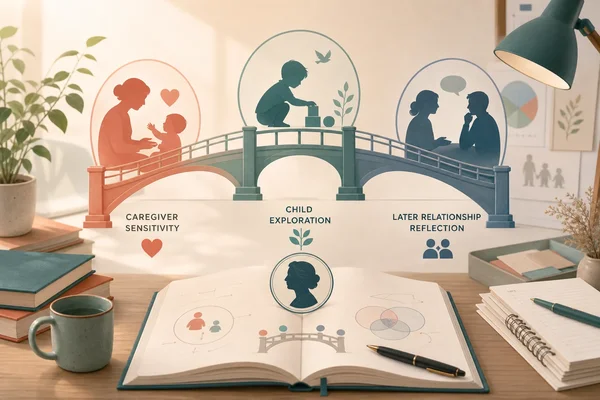
Ainsworth did not create a separate theory that replaced Bowlby's. Instead, attachment theory by Ainsworth gave Bowlby's ideas a careful observational method. She studied how infants used a caregiver as a safe base for exploration and as a haven during stress. In plain English, she asked: when a young child is uncertain, do they trust the caregiver enough to explore, return for comfort, and settle again?
That question sounds simple, but it changed developmental psychology. Before Ainsworth, attachment could be discussed as a broad emotional bond. After her work, researchers had a way to describe how children balanced closeness, distress, avoidance, resistance, and exploration. The key was the whole sequence: exploration before separation, distress during absence, and especially reunion behavior when the caregiver returned.
A short Mary Ainsworth attachment theory summary is this: early caregiver responsiveness helps shape expectations about comfort, attention, and protection. Those expectations can influence emotion regulation and relationships, though they are not destiny. Ainsworth kept the theory grounded in observable behavior instead of turning attachment into a vague personality label.
How Ainsworth and Bowlby Shaped Attachment Theory Together
Bowlby and Ainsworth attachment theory is often described as joint work because they contributed different strengths. Bowlby developed the broad framework. He argued that attachment behavior has an adaptive function: infants seek proximity to caregivers because care, protection, and responsiveness support survival and development. Ainsworth brought detailed observation, fieldwork, and classification to that framework.
Ainsworth's Uganda and Baltimore studies helped her notice that attachment was not only about physical closeness. A child might stay near a caregiver because the caregiver feels safe, or because the child is anxious and uncertain. Another child might appear independent, yet avoid comfort when stressed. These differences made sensitivity and reunion behavior central to attachment research.
In short, Bowlby explained the attachment system. Ainsworth made its individual patterns observable and researchable.
Mary Ainsworth's Strange Situation in Plain English
The Mary Ainsworth Strange Situation is a structured observation designed for young children, often around the end of the first year and into toddlerhood. It places the child in a mildly unfamiliar room with toys, the caregiver, and a stranger. Across brief episodes, the caregiver leaves and returns. Researchers watch how the child explores, reacts to separation, responds to the stranger, and reconnects with the caregiver.
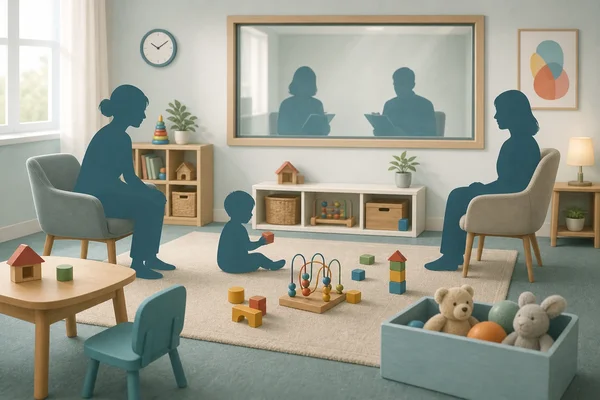
The procedure matters because attachment behavior is easiest to see when the child has a reason to need support. A familiar home may not activate the attachment system strongly enough. A frightening setting would be unethical and unhelpful. The Strange Situation sits in the middle: unfamiliar enough to reveal safe-base and haven patterns, but brief and controlled.
For readers, the most useful takeaway is not to copy the procedure at home. It is a research method, not a parenting test or a relationship quiz. Its value is conceptual. It shows that attachment is a pattern across stress and repair. In adult relationships, the same broad idea often appears as a question: when closeness feels uncertain, do I seek connection directly, pull away, protest, freeze, or settle after reassurance?
The Attachment Styles Ainsworth Identified
Ainsworth's original classifications included three main infant attachment patterns. Modern writing often maps these onto the language of safety-based, anxious, avoidant, and disorganized attachment styles, but it helps to know the history. Ainsworth identified safety-based, avoidant, and resistant or ambivalent patterns. The fourth pattern, disorganized or disoriented attachment, came later through Main and Solomon attachment theory research.
Safety-based attachment
Children in the safety-based pattern usually explore when the caregiver is present, show some distress when separated, and are comforted when the caregiver returns. The important part is flexible trust. The caregiver functions as a safe base for exploration and a haven when stress rises.
In adult self-reflection, this pattern does not mean never feeling anxious or never needing reassurance. It usually means closeness and independence can coexist. A person can ask for support, receive care, and return to everyday life without being consumed by fear or needing to shut down.
Avoidant attachment
Avoidant children may show little visible distress when the caregiver leaves and may avoid or ignore the caregiver during reunion. This can look like independence, but Ainsworth's framework asks a deeper question: has the child learned that showing need is not useful?
For adults, avoidant patterns may show up as discomfort with dependence, a strong preference for self-reliance, or a tendency to minimize needs. This is not a moral flaw. It can be a learned strategy for staying regulated when closeness feels demanding or unreliable.
Resistant or ambivalent attachment
Resistant or ambivalent children often become very distressed when the caregiver leaves, yet are not easily soothed when the caregiver returns. They may seek contact and resist it at the same time. The pattern suggests uncertainty about whether comfort will be available or effective.
In adult relationships, this can resemble anxious pursuit: wanting closeness intensely, scanning for signs of rejection, and finding reassurance hard to absorb. Again, the point is not to blame the person. The point is to notice the strategy and ask what kind of support, boundaries, and communication help the nervous system settle.
Why the fourth attachment style came later
When people ask, "What are the 4 attachment styles according to Ainsworth?" the precise answer is that Ainsworth's original system had three main categories. Mary Main and Judith Solomon later described disorganized or disoriented attachment for children whose behavior did not fit the organized safety-based, avoidant, or resistant patterns. Disorganized behavior may look contradictory, confused, frozen, or conflicted around the caregiver.

That distinction matters for accuracy. Ainsworth theory attachment searches often lead to four-style charts, but the history is layered. Ainsworth's Strange Situation created the foundation. Main and Solomon refined the system when some children's responses showed conflict that could not be captured by the first three categories.
Why Caregiver Sensitivity Matters in Ainsworth's Work
Ainsworth's contribution was not only classification. She also emphasized caregiver sensitivity: noticing a child's cues, interpreting them accurately, and responding in a timely, appropriate way. Sensitive care does not mean perfect care. It means the caregiver is generally available enough that the child can build expectations of safety.
This idea is one reason Ainsworth's work still matters outside developmental laboratories. It reframes attachment as a relationship pattern, not a fixed defect inside the child. A child who avoids, resists, or becomes disorganized is not "bad at attachment." The behavior is a strategy formed in a relational context. In adulthood, that same compassionate lens can reduce shame. Patterns may have made sense at one time, even if they now create friction.
There are also limits. The Strange Situation was developed in particular cultural and research contexts, and attachment behaviors can look different across families, caregiving arrangements, and temperaments. Ainsworth's ideas are best used for asking better questions, not for judging parents, children, partners, or yourself.
How Ainsworth's Ideas Connect to Adult Relationships
Ainsworth studied infants and caregivers, but her work helped later researchers think about adult intimacy. Adult attachment research often focuses on anxiety and avoidance: how strongly someone fears abandonment and how strongly they avoid dependence or emotional closeness. Those adult dimensions are not identical to infant categories, but they echo the same safe-base question.
If you read about Mary Ainsworth attachment styles because of a romantic relationship, pay attention to patterns rather than labels. Do you protest when you feel distance? Do you deactivate needs and tell yourself you are fine? Does reassurance land, or does it slip away quickly? These questions are more useful than forcing every behavior into a neat box.
For a private starting point, relationship pattern reflections can help you organize what you notice before you talk with a therapist, coach, or partner. Keep the boundary clear: self-reflection tools can support insight, but they do not evaluate your whole history, culture, mental health, or relationship safety.
A Gentle Way to Use Ainsworth's Theory for Self-Reflection
The most useful way to apply Ainsworth's theory of attachment is to observe your own stress-and-repair cycle. Choose one recent relationship moment that felt activating. Then write down what happened before the trigger, what you felt in your body, what you wanted to do, what you actually did, and what helped you settle afterward.

Try three prompts:
- When I feel unsure of someone's availability, my first move is usually to move closer, pull back, protest, freeze, or ask directly.
- Reassurance helps me most when it is specific, timely, respectful, and paired with consistent behavior.
- One safe-base behavior I can practice this week is naming a need clearly without demanding that the other person manage all of my feelings.
If the topic brings up trauma, fear, or ongoing relationship harm, consider professional support. Attachment language should never be used to excuse unsafe behavior or pressure someone to stay in a damaging relationship. It is a way to understand patterns and practice steadier connection.
You can also review attachment theory learning resources when you want a low-pressure place to connect the research language with everyday relationship examples. The goal is not to decide which label explains everything. The goal is to notice what helps you feel safe, responsive, and able to repair.
FAQ
What was Ainsworth's attachment theory?
Ainsworth's attachment work expanded Bowlby's theory by showing how infant-caregiver bonds could be observed and classified. Her Strange Situation procedure focused on exploration, separation, stranger response, and reunion behavior to identify safety-based, avoidant, and resistant or ambivalent patterns.
What is Bowlby Ainsworth attachment theory?
Bowlby Ainsworth attachment theory refers to the combined framework shaped by John Bowlby and Mary Ainsworth. Bowlby described the attachment system and its protective function. Ainsworth added observation, caregiver sensitivity, safe-base behavior, and the Strange Situation classification system.
What are the 4 attachment styles according to Ainsworth?
Strictly speaking, Ainsworth identified three original patterns: safety-based, avoidant, and resistant or ambivalent. The fourth pattern, disorganized attachment, was added later by Mary Main and Judith Solomon to describe conflicted or disoriented behavior that did not fit the original categories.
What is the Mary Ainsworth Strange Situation?
The Strange Situation is a structured research observation in which a young child experiences brief separations and reunions with a caregiver in an unfamiliar room. Researchers observe exploration, distress, stranger response, and reunion behavior to understand attachment patterns.
How did Ainsworth contribute to attachment theory?
Mary Ainsworth contributed the safe-base concept, detailed observations of caregiver-child interaction, the Strange Situation procedure, and the original attachment classifications. Her work gave Bowlby's theory a practical research method and helped make caregiver sensitivity central to attachment science.
Are Ainsworth's attachment styles the same as adult attachment styles?
They are related but not identical. Ainsworth's categories came from infant-caregiver observations. Adult attachment research often uses dimensions such as anxiety and avoidance to describe patterns in close relationships. Adult patterns can change with experience, reflection, and supportive relationships.
Is attachment theory a diagnosis?
No. Attachment theory is an educational and research framework, not a diagnosis. It can help people reflect on relationship patterns, but it should not replace support from a qualified professional when distress, trauma, safety concerns, or mental health symptoms are present.