Attachment Styles Worksheet: Printable Prompts for Relationship Self-Reflection
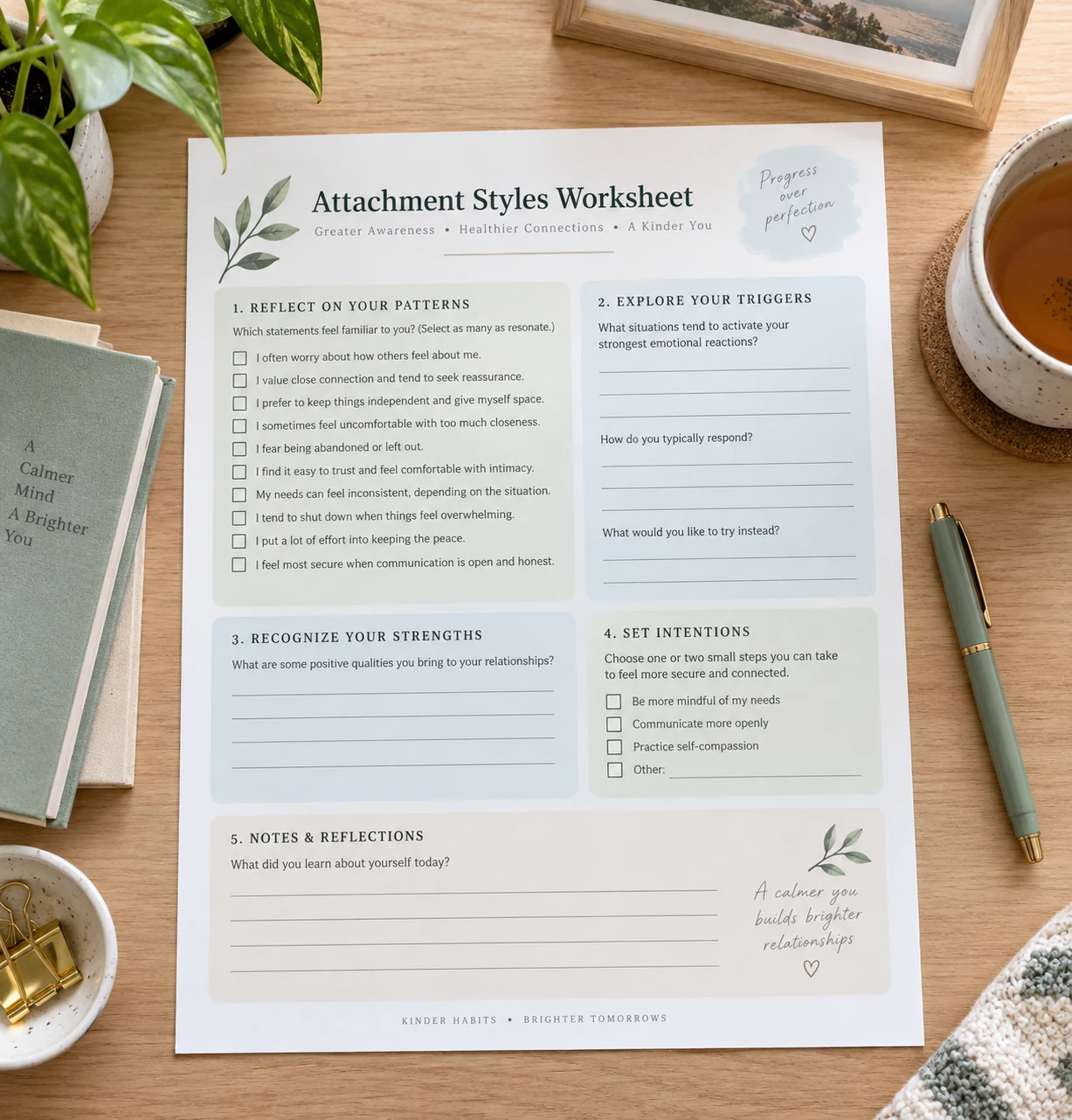
An attachment styles worksheet can turn a vague relationship pattern into something you can actually observe: what you feel, what you expect, how you protect yourself, and what might help you respond with more security. Search results often focus on a quick attachment styles worksheet PDF, but the worksheet is only useful when the prompts invite careful reflection rather than a rushed label. If you want a gentle starting point before filling out printable attachment theory worksheets, you can also explore a relationship self-reflection quiz and use the notes below to make sense of what comes up.
What an Attachment Styles Worksheet Is For
A good worksheet is not meant to sort your whole personality into a box. It is a structured reflection tool. It helps you slow down enough to notice the difference between a present-day relationship event and the older expectations that may be shaping your reaction.
Most attachment theory worksheets ask about four broad patterns: secure, anxious, avoidant, and disorganized or fearful-avoidant attachment. Secure patterns often involve comfort with closeness and independence. Anxious patterns may involve fear of rejection, strong reassurance needs, or quick alarm when contact changes. Avoidant patterns may involve emotional distance, discomfort with dependence, or a strong need to stay self-reliant. Disorganized patterns can include mixed signals: wanting closeness while also feeling unsafe with it.
The worksheet matters because attachment language can feel abstract. A page of prompts makes the idea more concrete. Instead of asking, "What is my attachment style?" it asks, "What happened, what did I assume, what did I do next, and what would a more secure response look like?"
What to Include in a Printable Attachment Theory Worksheet
Printable attachment theory worksheets work best when they move from simple observation to gentle action. A useful page does not need to be long. It should create enough space for pattern recognition without trying to replace therapy, coaching, or a full clinical assessment.
Include these sections:
- Relationship context: partner, friend, family member, date, or recurring situation.
- Trigger: the moment that activated strong emotion, such as delayed replies, conflict, silence, criticism, or unexpected closeness.
- Body signal: tight chest, numbness, restlessness, urge to leave, urge to send several messages, or difficulty sleeping.
- Story your mind told: "I am too much," "They will leave," "I cannot rely on anyone," or "I need to handle this alone."
- Protective move: pursuing, withdrawing, pleasing, shutting down, testing, overexplaining, or avoiding the conversation.
- Secure alternative: one small response that respects both connection and boundaries.
This format can support someone who wants an attachment styles worksheet pdf free of jargon. It can also help a reader compare worksheet notes with an attachment style quiz without treating either one as the final word.
Quick Reference: The 4 Attachment Styles PDF Section
Many people search for a 4 attachment styles PDF because they want a concise chart. A chart is helpful, but it should be framed as a learning aid. People can show different strategies in different relationships, and stress can make an old strategy look louder than usual.
| Style | Common relationship expectation | Worksheet question |
|---|---|---|
| Secure | Closeness and independence can both be safe. | What helped me stay steady or repair after tension? |
| Anxious | I may be left, forgotten, or not valued enough. | What reassurance did I want, and how did I ask for it? |
| Avoidant | Depending on others may feel risky or uncomfortable. | What feeling did I move away from, and what boundary did I need? |
| Disorganized | I want closeness, but closeness may also feel threatening. | What mixed signals showed up in my body or behavior? |
If you are making a 4 attachment styles PDF free download for personal study, keep the language neutral. "Anxious" does not mean needy or broken. "Avoidant" does not mean cold or uncaring. These words describe learned strategies for managing closeness, distance, safety, and vulnerability.

Prompts for Anxious Attachment Worksheets
An anxious attachment worksheet PDF should help the reader notice the cycle between alarm, reassurance-seeking, and relief. The goal is not to shame the need for closeness. The goal is to separate the real need from the urgent strategy.
Try these prompts:
- What happened right before I felt the urge to seek reassurance?
- What did I fear would happen if I did nothing?
- What did I need: information, comfort, consistency, repair, or closeness?
- Did my request make my need clear, or did it come out as protest, testing, or accusation?
- What is one direct sentence I could use next time?
For example, "You never care about me" might become, "When plans change late, I feel unsettled. Can we agree on how we will update each other?" The second version still honors the need for reassurance, but it gives the other person a clearer path to respond.
Anxious attachment worksheets are strongest when they include self-soothing before communication. A short pause, breathing practice, walk, journal entry, or supportive message to a trusted friend can reduce urgency enough to make the real request easier to name.
Prompts for Avoidant Attachment Worksheets
Avoidant attachment worksheets PDF searches often come from people who recognize a pattern of pulling away. The worksheet should not frame distance as selfishness. In many cases, distance has been a protection strategy: a way to avoid pressure, conflict, dependence, or emotional overwhelm.
Useful prompts include:
- What kind of closeness felt like too much?
- What did I want to protect: autonomy, calm, privacy, control, or competence?
- Did I communicate a boundary, or did I disappear, delay, intellectualize, or minimize?
- What emotion was easiest to dismiss?
- What is one small version of connection I could tolerate without overriding myself?
For avoidant patterns, the secure alternative is usually not forced vulnerability. It may be a clearer boundary: "I want to talk about this, but I need twenty minutes to settle first." It may also be a small bid for connection: "I am quiet because I am processing, not because I do not care."
How to Use the Worksheet Without Over-Labeling Yourself
The biggest risk with attachment content is turning a reflection tool into a fixed identity. Worksheets are most helpful when you use them as snapshots. They show what happened in one relationship moment, not everything about who you are.
Use a three-pass method:
- Fill it out soon after a relationship moment, while the details are still clear.
- Re-read it later, when your nervous system is calmer.
- Look for patterns across several entries instead of drawing a conclusion from one hard day.
This is especially important if you see traits from more than one style. Many people do. You might feel anxious with someone inconsistent, avoidant when you feel pressured, and secure with a friend who communicates clearly. The pattern is the point.

Turning Worksheet Notes Into a Secure Next Step
After you complete an attachment styles worksheet, choose one next step that is small enough to practice. Secure attachment is built through repeated experiences of clarity, repair, boundaries, and care. It rarely comes from one insight alone.
Here are a few low-pressure options:
- Name one trigger you want to understand better.
- Write one direct request you can use in a future conversation.
- Practice one pause before reacting.
- Identify one boundary that protects connection rather than ending it.
- Bring the worksheet to a therapist, counselor, or trusted support person if the topic feels heavy or tied to trauma.
You can also use a gentle attachment style tool as a companion to your worksheet notes. Treat the result as a conversation starter: What fits? What does not fit? What would you like to practice differently in the next relationship moment?
FAQ
What is an attachment styles worksheet?
An attachment styles worksheet is a guided reflection page that helps you notice relationship triggers, emotional reactions, protective behaviors, and possible secure alternatives. It usually explains secure, anxious, avoidant, and disorganized attachment patterns in simple language.
Is an attachment styles worksheet PDF enough to know my style?
It can help, but it should not be treated as a complete assessment. A PDF worksheet captures self-reflection at one moment in time. Patterns across several relationships, honest feedback, and professional support can give a fuller picture.
What should be in an anxious attachment worksheet PDF?
It should include prompts about reassurance needs, fear of rejection, protest behaviors, body signals, and direct communication. The most useful version also includes a self-soothing step before asking for connection.
What should be in avoidant attachment worksheets PDF?
They should include prompts about emotional distance, independence, discomfort with dependence, shutdown patterns, and boundaries. A helpful worksheet also asks what kind of connection might feel manageable instead of forcing immediate vulnerability.
Can I use one worksheet for all four attachment styles?
Yes. A broad worksheet can include a 4 attachment styles chart, then separate prompts for anxious, avoidant, secure, and disorganized patterns. This is often better than using only one label because many people notice mixed traits.
Are printable attachment theory worksheets useful for couples?
They can be useful when both people approach them with curiosity rather than blame. Each person can fill out their own worksheet first, then compare triggers, needs, and repair ideas. If conflict feels unsafe or overwhelming, professional support may be a better setting.
How often should I fill out an attachment worksheet?
Use it after meaningful relationship moments, not every minor irritation. Once a week or after a recurring trigger is usually enough for pattern spotting. The aim is reflection, not constant self-monitoring.