Insecure Attachment AP Psychology Definition: Meaning, Examples, and Types
In AP Psychology, insecure attachment is an attachment pattern in which a child does not consistently use a caregiver as a safe base for comfort, exploration, and reunion. The term usually appears in development questions about early social bonds, caregiver responsiveness, and classic attachment research. If you are studying the insecure attachment AP Psychology definition, it helps to connect the definition to observable behavior: clinging, avoiding, resisting comfort, freezing, or showing confused reunion responses. For personal reflection outside class, a gentle attachment style self-reflection tool can help you explore related relationship patterns without treating a quiz result as a formal clinical assessment.

The AP Psychology Definition in One Sentence
A strong AP Psych definition should be short enough to remember but specific enough to use in a scenario. Try this: insecure attachment is a less stable emotional bond shown when a child has difficulty seeking comfort from, trusting, or confidently exploring near a caregiver because the caregiver relationship has not felt consistently safe or responsive.
That definition does three useful things. First, it identifies attachment as an emotional bond, not simply affection or liking. Second, it ties the pattern to caregiver responsiveness, which is the core developmental idea. Third, it points to behavior that can be observed in a research setting, especially separation and reunion.
For exams, avoid defining insecure attachment as "bad parenting" or "a child who dislikes a parent." Those are too broad and too judgmental. AP Psychology usually wants you to understand a pattern, not blame a person. A child may show insecurity because care has been inconsistent, unavailable, frightening, stressful, or hard to predict. The important concept is that the child has trouble relying on the caregiver as a dependable secure base.
Secure vs Insecure Attachment in AP Psychology
Secure attachment means a child generally trusts the caregiver as a safe base. In a classic classroom example, a securely attached child may become upset when the caregiver leaves but can usually be comforted when the caregiver returns. The child then returns to exploration or play.
Insecure attachment is different because comfort, exploration, and reunion do not work as smoothly. One child may avoid the caregiver after reunion. Another may cling while also resisting comfort. Another may show confused or disoriented behavior. In all cases, the key AP Psychology contrast is not "happy child versus unhappy child." The contrast is whether the caregiver relationship functions as a predictable base for security.
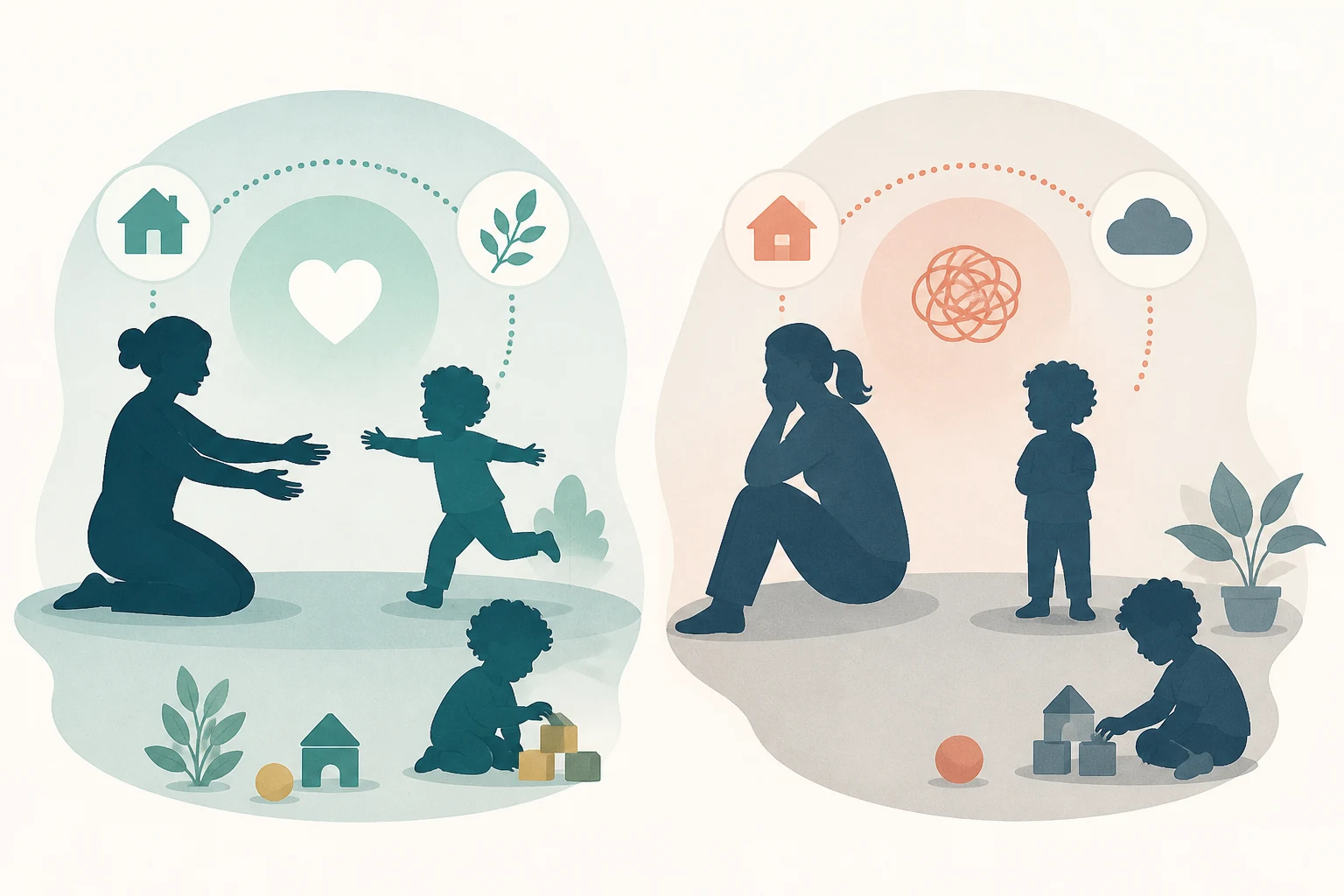
This contrast also helps with adult attachment language. Adult relationship patterns are not identical to infant attachment categories, but the vocabulary overlaps. Someone learning about their relationship patterns through a relationship pattern quiz may see words like secure, anxious, avoidant, and disorganized. In AP Psychology, however, keep your answer grounded in development: early bonds, caregiver responses, exploration, distress, and reunion.
The Main Insecure Attachment Types
AP Psychology classes often discuss insecure attachment as a broad category with several patterns. Different textbooks vary in wording, but three common insecure patterns are avoidant, anxious-resistant or ambivalent, and disorganized.
Insecure Avoidant Attachment
Insecure avoidant attachment describes a pattern in which a child appears emotionally distant from the caregiver. In a separation-and-reunion scenario, the child may show little visible distress when the caregiver leaves and may avoid or ignore the caregiver when the caregiver returns.
The AP Psychology point is not that the child has no feelings. The visible behavior is the clue: the child does not openly seek comfort from the caregiver, even when the situation would normally activate attachment needs. A test question might describe a child who turns away, continues playing without greeting the caregiver, or avoids contact after reunion.
Insecure Anxious or Ambivalent Attachment
Insecure anxious attachment, often called anxious-resistant or ambivalent in child development contexts, describes a pattern in which a child is intensely distressed by separation and not easily comforted at reunion. The child may cling to the caregiver but also push away, resist soothing, or remain angry.
For AP Psychology, the phrase "inconsistent caregiving" is often connected to this pattern. If comfort has sometimes been available and sometimes unavailable, the child may become highly focused on keeping the caregiver close. In a scenario, look for clinginess combined with difficulty settling after the caregiver returns.
Insecure Disorganized Attachment
Insecure disorganized attachment describes confused, contradictory, or disoriented behavior around the caregiver. A child may approach and then freeze, move toward the caregiver while looking away, seem dazed, or show fear in a situation where the caregiver would normally be the source of comfort.
This pattern is often taught as the most behaviorally disorganized of the insecure categories. On an exam, the giveaway is not simple anxiety or simple avoidance. It is a lack of organized strategy for seeking safety. The child seems caught between wanting closeness and feeling unsure how to handle it.
AP Psychology Examples You Can Recognize
Examples matter because AP Psychology questions often test concepts through short scenarios. Instead of memorizing only labels, practice matching the behavior to the attachment pattern.
If a child cries when a caregiver leaves, crawls toward the caregiver at reunion, accepts comfort, and then returns to playing, that is most consistent with secure attachment. The child uses the caregiver as a base and can recover.
If a child barely looks at the caregiver after reunion and avoids contact, that points toward insecure avoidant attachment. The child may seem independent, but the AP concept is about limited comfort-seeking.
If a child becomes extremely upset when the caregiver leaves, clings when the caregiver returns, yet pushes away or cannot be soothed, that points toward insecure anxious-resistant or ambivalent attachment. The behavior combines intense proximity seeking with resistance.
If a child shows contradictory behavior, freezes, appears confused, or approaches in an odd and fearful way, that points toward insecure disorganized attachment. The behavior does not fit a clear strategy for getting comfort.

Here is a simple study move: underline the reunion behavior first. Many questions include separation details, but the return of the caregiver often gives the clearest clue. Does the child seek comfort and recover, avoid contact, cling while resisting comfort, or act confused? That sequence usually tells you more than one isolated emotion.
How Insecure Attachment Fits Attachment Theory
Attachment theory explains how early relationships can shape expectations about closeness, safety, and support. In AP Psychology, names often linked to this unit include John Bowlby, who emphasized attachment as a biologically meaningful bond, and Mary Ainsworth, whose Strange Situation research helped classify attachment patterns.
The Strange Situation is useful because it gives behavior a structure. A caregiver and child enter a room, the child has a chance to explore, the caregiver leaves, a stranger may enter, and the caregiver returns. The child's response to separation and reunion helps researchers describe the attachment pattern.
When you define attachment for AP Psychology, include the idea of a caregiver as a secure base. Children use trusted caregivers both for comfort and for confidence to explore. Insecure attachment means that secure-base function is disrupted or uncertain. The child may still care about the caregiver deeply, but the strategy for closeness and comfort is less settled.
It is also important to avoid turning the definition into a fixed life sentence. Attachment patterns describe tendencies, not permanent identity. Later relationships, stable support, reflection, and skill-building can all influence how people relate to closeness over time.
Common Mistakes in AP Psych Answers
One common mistake is mixing up insecure attachment with separation anxiety. A child can be upset when a caregiver leaves and still be securely attached if the child accepts comfort at reunion. Distress alone is not the whole answer.
Another mistake is treating avoidant attachment as emotional strength. In AP Psychology terms, avoidant behavior is not proof that a child does not need connection. It is a pattern in which the child does not openly use the caregiver for comfort.
A third mistake is using adult relationship labels without the developmental evidence. "Anxious attachment" in dating content may sound familiar, but an AP Psychology free-response answer should connect the term to caregiver responsiveness, early bonds, and observable child behavior.
A fourth mistake is overgeneralizing from one moment. Attachment patterns are inferred from repeated behavior in a relationship context. A single tantrum, shy reaction, or independent moment is not enough to define a whole pattern.
Quick Study Checklist
Use this checklist when reviewing insecure attachment psychology definition questions:
- Identify the caregiver-child bond.
- Look for separation and reunion cues.
- Ask whether the caregiver works as a secure base.
- Match avoidant behavior with emotional distance at reunion.
- Match anxious-resistant behavior with clinginess plus resistance.
- Match disorganized behavior with confused or contradictory actions.
- Keep the wording educational and behavior-based.
If you can explain the behavior in one sentence, you probably know the concept. For example: "The child avoids the returning caregiver, so the scenario best illustrates insecure avoidant attachment." That sentence names the pattern and gives evidence.
Use the Definition as a Study Tool, Not a Personal Label
The insecure attachment AP Psychology definition is useful because it turns a big emotional topic into a clear developmental concept. For school, focus on the definition, the Strange Situation, caregiver responsiveness, and the difference between avoidant, anxious-resistant, and disorganized patterns.
For real life, use the language more gently. Attachment patterns can be a helpful mirror for relationship habits, but they should not be used to reduce a person to a label. If the topic feels personally relevant, you can explore it through journaling, conversation, trusted support, or an educational attachment style learning resource. For complex distress, safety concerns, or relationship harm, consider support from a qualified professional.

FAQ
What is insecure attachment in psychology?
Insecure attachment is a pattern in which a child has difficulty using a caregiver as a reliable source of comfort and security. The child may avoid the caregiver, cling but resist comfort, or show confused behavior when seeking safety.
What is the insecure attachment AP Psychology definition?
For AP Psychology, insecure attachment means an early attachment bond marked by inconsistent, avoidant, resistant, or disorganized comfort-seeking behavior, especially during separation and reunion with a caregiver.
What are some examples of insecure attachment?
Examples include a child ignoring a caregiver after reunion, clinging while angrily resisting comfort, or freezing and acting confused when the caregiver returns. Each example shows a different insecure pattern.
What are the different attachment styles in AP Psych?
AP Psychology commonly contrasts secure attachment with insecure avoidant, insecure anxious-resistant or ambivalent, and insecure disorganized attachment. Secure attachment involves using the caregiver as a safe base; insecure patterns show less stable comfort-seeking.
What is secure attachment vs anxious attachment?
Secure attachment usually involves distress that can be soothed and a return to exploration. Anxious-resistant attachment involves intense distress, strong clinging, and difficulty being comforted after the caregiver returns.
Is insecure attachment the same as attachment disorder?
No. In AP Psychology, insecure attachment is a developmental pattern used to describe caregiver-child relationship behavior. An attachment disorder is a clinical term with a different purpose and should be evaluated only by qualified professionals.